Imagine a close friend whose judgment you respect recommends a restaurant they’ve tried recently. They rave about how much they loved the food, enjoyed the atmosphere, and were impressed by the service. You decide to give it a try, but before making a reservation, you look it up on Google.
That’s when you notice something troubling.
The restaurant has a disappointing overall rating, and in contrast to your friend’s account of their visit, several recent reviewers describe poor service, long wait times, and meals that weren’t worth the price.
Suddenly, your close friend’s enthusiastic recommendation doesn’t seem quite so convincing.
Now imagine the opposite situation. You’re looking to dine at a restaurant in an unfamiliar neighbourhood. You call up Google on your phone to help locate potential dining establishments and aid in your decision-making. You don’t recognize any of the names of the places it returns in the search, but one restaurant has hundreds of positive reviews, many containing detailed accounts of excellent meals and great service.
Which would you be inclined to choose?
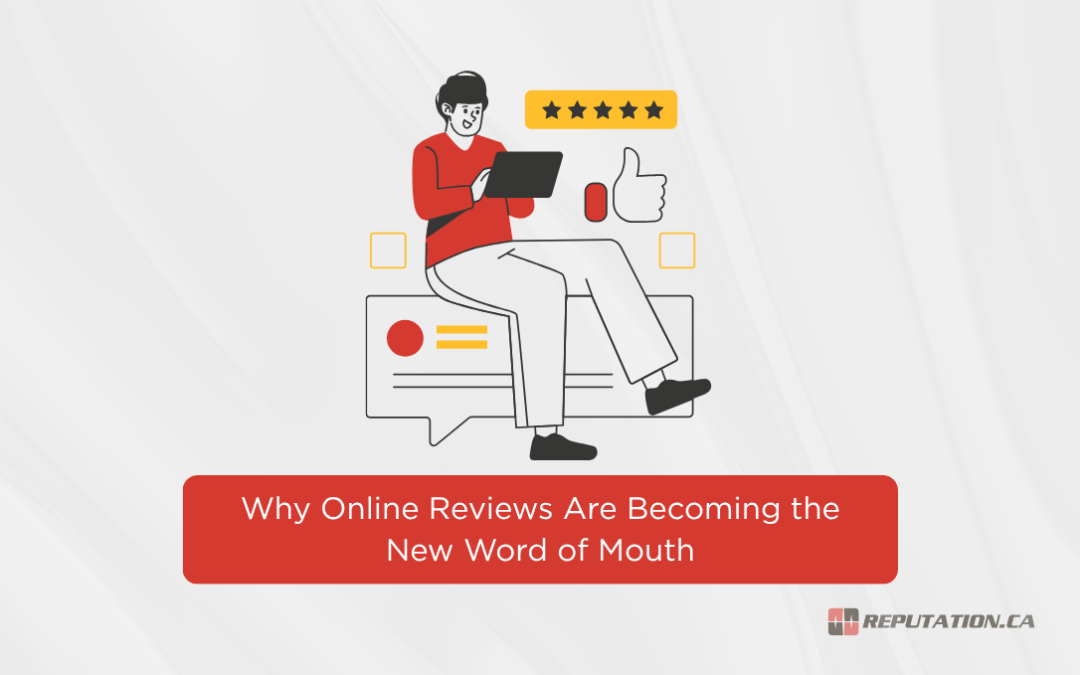
These are the kinds of decisions millions of consumers make every day. And increasingly, online reviews are carrying almost as much weight as recommendations from people they know personally.
A 2026 survey of 2,220 Canadians conducted by Butterly found the following when consumers are given conflicting information about a business:
- 69.3% trust recommendations from someone they know personally.
- 57.4% trust recent online reviews from verified customers.
- 15.3% trust information supplied directly by the brand.
- 9.4% trust creators and influencers.
For business owners, those numbers deserve close attention.
Historically, positive word of mouth from friends, family, neighbours, and co-workers has always been the single most trustworthy way to attract customers. But these days, a stranger’s experience posted online can be almost as persuasive.
And unlike a private conversation between two people, that online review may be seen by hundreds or thousands of prospective customers, each flirting with the idea of making a purchase, and so carries with it increased reach and visibility.
Online Reviews Are Becoming a Major Source of Consumer Trust

Not so long ago, businesses could rely heavily on traditional advertising, brand recognition, and their established reputation to attract new customers. These things still matter, of course. But they don’t necessarily carry the same kind of influence as first-hand accounts from people who have actually purchased a product or used a service and then taken the time to publish their own experiences.
The Butterly survey serves to illustrate this distinction well. It states that as of Q3 2026, when consumers encounter conflicting information, they’re much more inclined to believe the testimony of other customers than the businesses selling the products or services, even if it is found online rather than received from in-person word-of-mouth.
That means that even though a business might spend a fortune on advertising, commission an attractive and user-friendly website, and publish glowing descriptions of its products or services, when prospective customers want to know whether those claims are accurate, they look elsewhere. And the data shows they’re increasingly interested in what other customers have to say on the internet.
Consider someone searching for a roofing contractor, for example.
The contractor’s website might describe the company as reliable, professional, and committed to customer satisfaction. That’s all well and good, but those are claims made by the business itself.
The business has an interest in portraying itself in the best possible light, and customers are savvy enough to understand this.
However, a detailed Google review or Reddit comment from a homeowner describing how the contractor arrived on time, completed the work well and within budget, and then cleaned up after themselves before leaving offers something entirely different: a first-hand account of what actually happened by the person who actually paid for the service.
That distinction helps explain why online reviews have become such an important part of a business’s overall reputation.
In short, online reviews allow prospective customers to learn from the experiences of people they’ve never met.
A Good Reputation Yesterday Doesn’t Guarantee Customers Tomorrow
One of the more interesting findings from Butterly’s research is about the relationship between brand recognition and recent customer feedback.
Survey respondents were asked to choose between two similar products: one from a familiar brand with average recent reviews, and another from an unfamiliar brand with excellent recent reviews.
The results were telling:
- 48.7% chose the unfamiliar brand with excellent reviews.
- 20% preferred the established brand with average reviews.
- 31.3% wanted additional information before making a decision.
Think about what that means for a moment.
A company can spend decades building up its name, developing healthy customer relationships, and transforming itself into a recognized leader in its industry. Yet, when pitted head-to-head, a newer competitor with stronger recent customer feedback on the internet may still ultimately win the sale.
And the implications of this phenomenon extend well beyond consumer products.
Imagine two dental clinics serving the same community. One has operated for 25 years but has accumulated numerous complaints about appointment scheduling and customer service from patients on Trustpilot or its Google Review page. The other clinic opened recently but has built a strong collection of detailed, positive online reviews. A prospective patient who has never visited either clinic may likely be drawn toward making an initial appointment with the newer one.
Of course, reviews aren’t the only consideration. Pricing, location, availability, and personal recommendations still influence decisions. Nevertheless, in the digital age, an established reputation is no longer something a business can simply take for granted.
For newer businesses, this presents an opportunity. Positive reviews can help them compete with larger, better-known organizations without having to pay a king’s ransom for ad buys and elaborate marketing campaigns.
For already established businesses, it presents a warning: the experiences customers are reporting today may well matter more to prospective buyers than a company’s achievements from twenty, ten, or even five years ago.
Why Authentic Reviews Matter More Than Perfect Ratings

Given the importance of customer reviews, it’s perfectly understandable that business owners are inclined to want as many five-star ratings as possible.
But research indicates that there’s a snag associated with that approach.
Consumers are becoming increasingly suspicious of reviews that appear too good to be true. A 2025 report published by the Retail Council of Canada drawing on responses from more than 2,000 Canadians nationwide found the following:
“… 62% of Canadians admit to being wary of products that hold a perfect 5-star rating. This skepticism is most pronounced among younger generations, with 70% of Gen Z and 68% of Millennials expressing doubt about perfect ratings… 57% of Gen X and 56% of Baby Boomers also share this sentiment but to a slightly lesser degree.”
This widespread skepticism is understandable. After all, a flawless rating can raise questions in the minds of readers about whether some, if not many, of the reviews have been fabricated, paid for, or otherwise manipulated.
Supporting this, in the more recent Butterly survey, respondents identified several specific warning signs that made them question whether customer reviews were genuine:
- 55.9% were suspicious of reviews containing unusually similar wording.
- 35.9% questioned review profiles where almost every rating was five stars.
- 34.7% were suspicious of reviews that sounded overly polished or promotional.
- 25.8% identified suspected AI-generated writing as a major warning sign.
In other words, a collection of glowing reviews can actually cast larger doubts in the minds of consumers if those reviews don’t seem genuine.
Imagine visiting a Google Business Profile for a furniture store and finding not one, not two, but dozens of reviews sharing nearly identical remarks about outstanding service, exceptional professionalism, and high-quality products.
Would you find these reviews convincing? Or, as you scrolled through and saw the same word choice, phraseology, and sentence structure used in all of them, would you think to yourself, “these have been faked”? The latter is most likely, especially if the reviews in question were all posted within the same short period of time.
Compare that with a business whose reviews contain drastically different writing styles, specific and even granular details of customer experiences, as well as a mixture of positive feedback with occasional criticism.
The second profile would be much more believable.
This doesn’t mean businesses should welcome negative reviews, but it’s important to remember that they are something of an inevitability when providing goods or services to the general public. A total absence of them sets off alarm bells, and frankly, makes an online business profile look at least somewhat inauthentic.
Importantly, the Butterly survey also found that consumers don’t necessarily abandon a purchase because of one negative review. Only 2.8% of respondents said a single credible negative review would prevent them from buying a product.
Supporting this, the Retail Council of Canada report found that 95% of Canadian shoppers surveyed at least occasionally look for negative reviews before making a purchase. So, rather than automatically rejecting a business because of negative feedback, prospective customers seem to consider several factors:
- How recent and detailed the complaint is.
- Whether other customers report the same problem.
- Whether the criticism concerns the product itself or something else, such as shipping or delivery.
Also worth considering from a prospective customer’s perspective is that a single complaint about a delayed delivery is a very different matter than twenty-seven recent complaints detailing poor workmanship or dishonest billing.
The lesson for business owners is straightforward. Don’t become so focused on achieving a perfect rating that you lose sight of what reviews are supposed to represent: genuine accounts of customer experiences.
AI Is Making Real Customer Experiences Even More Valuable

There’s another omnipresent development making authentic online reviews particularly important these days: the recent saturation of the internet with AI-generated content.
Businesses can now produce advertising copy, long-form content, promotional videos, social media posts, and, most importantly for this discussion, online reviews in a fraction of the time required prior to the launch of ChatGPT, Claude, Gemini, and the other now-ubiquitous AI tools. Consumers are very much aware of this, and as a result, are becoming more cautious about what they read online.
A September 2026 Gartner survey of 1,006 American consumers found that:
- 65% believe businesses are producing too much AI-generated marketing content.
- 57% have become less trusting of online brand messaging because of AI-generated content.
- 43% report relying more heavily on real people making recommendations for shopping.
- 35% now rely less on influencers for shopping advice because of the growing presence of AI-generated content.
These are important insights for businesses of all sizes. As promotional content becomes easier to produce, customers are placing greater value on evidence that real people have had positive experiences with a company. And online reviews provide exactly that, assuming they’re genuine.
AI is also changing how consumers research businesses and products.
Butterly found that 44.4% of respondents would use an AI-generated summary of customer reviews as an initial research tool but would continue investigating beyond that, often consulting the original reviews to verify them. Another 21.4% preferred to read customer reviews themselves without using AI as a gatekeeper.
This suggests that even when consumers use AI to compare their options, the original customer feedback is still important to them. So, maintaining a current and authentic collection of reviews is increasingly valuable, not despite the widespread adoption of AI-powered search, but in part because of it.
What Does This Mean for Business Owners?
The ever-expanding influence of online reviews presents both opportunities and challenges for businesses. On the one hand, a healthy accumulation of positive customer feedback can help attract new customers and bolster a company’s reputation. On the other hand, negative reviews can sour prospective customers before they ever even make contact with a business. According to Butterly, 25.3% of survey respondents said recent negative reviews could cause them to totally abandon a planned purchase.
For businesses looking to improve their online reputations, Reputation.ca has penned articles offering practical guidance on responding to negative customer reviews, handling both positive and negative feedback, and monitoring your online reputation.
In the end, building a well-populated review profile full of positive feedback comes down to encouraging customers to leave honest remarks, addressing any legitimate concerns that may arise on a case-by-case basis, and most importantly of all, consistently delivering positive customer experiences both online and in person.
Remember: Even though the digital sphere is the new popular forum for word-of-mouth, it is, by no means, the only place where reputations are made. What happens between a business and a customer in real life has a funny way of ending up online, too.
Your Customers Are Already Shaping Your Reputation

Despite all this, it’s also important to recognize that traditional word of mouth isn’t going anywhere. People will continue asking friends, relatives, neighbours, and co-workers for recommendations about dentists, furniture stores, and contractors, as well as doctors, technology manufacturers, and all the rest. Personal experience and trusted relationships will always influence purchasing decisions.
But as the 21st century marches on, the circle of people whose opinions matter in this respect has expanded enormously for ordinary consumers. Today, someone who has never visited your business, met your employees, or spoken directly with your customers can form an opinion about your business in a matter of seconds simply by reading its online reviews.
And as the Butterly research suggests and the Retail Council of Canada report supports, those reviews may carry almost as much weight as recommendations from people they know personally.
That’s why online reputation management for businesses is no longer just about protection from occasional public criticism. Now more than ever, it’s about encouraging genuine customer feedback, addressing legitimate concerns they might have, identifying potential problems before they escalate, and helping prospective customers feel confident about choosing your business.
For business owners already faced with a substantial number of negative reviews, improving the record is possible, but it takes time and consistent effort.
At Reputation.ca, we specialize in helping businesses monitor their online reviews, address damaging or misleading online content, develop effective review management strategies, and establish a stronger overall online reputation.
If negative customer feedback is affecting your business, or you’re looking to build up your online presence and attract new customers, contact Reputation.ca to discuss your options using the form below, or visit our reviews management services page for more information on how we can help.